

In a rapidly shifting corporate governance landscape, closing a top candidate is no longer the finish line for your talent strategy or your labour compliance status.
Since 15 April 2026, a national employee counts toward your Nitaqat ratio only when the contract is electronically authenticated on Qiwa [1]. The hire is real, the salary is paid, and the GOSI record exists, yet that headcount can stay invisible to the calculation until the employee signs in and accepts the contract.
One rule explains why workforce compliance has moved from back-office admin to a planning discipline. Qiwa, GOSI and Mudad now describe the same workforce from three angles, and the market has entered a three-year Nitaqat phase that targets the localization of more than 340,000 additional private-sector jobs [3]. The employers who do well are the ones who treat these systems as one workflow, not five separate chores.
This guide is the 2026 employer checklist: what each system does, what changed this year, what it costs to get wrong, what to confirm every month, and where a workforce partner saves time. MenaTalents manages these workflows as part of its employment administration and payroll outsourcing service, so the steps below reflect how the work gets done in practice.
What is workforce compliance for employers?
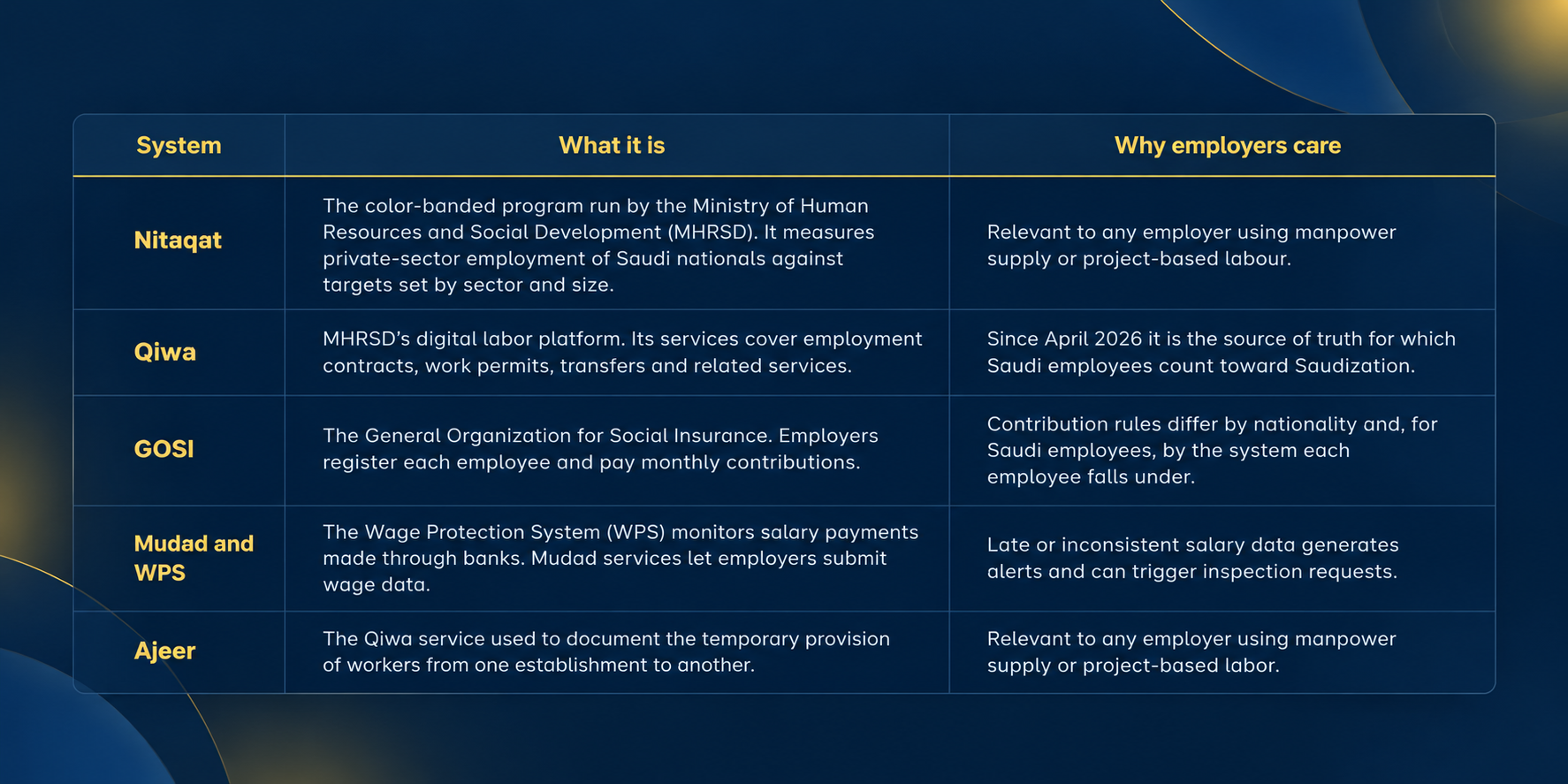
Workforce compliance is the discipline of keeping every employee’s contract, insurance, salary and permit records accurate, consistent and on time across the government platforms that regulate private-sector employment. Five names come up in almost every employer conversation:
What changed in workforce compliance in 2026?
Seven updates shape this year’s checklist, in date order.
- 22 January 2026: MHRSD announced a new three-year phase of Nitaqat Mutawar, starting in 2026, aimed at localizing more than 340,000 additional private-sector jobs for Saudi nationals [2][3].
- 9 February 2026 (published 25 February): the Minister issued Decision No. 112377 amending the schedule of violations and penalties under the Labour Law and its Implementing Regulations. Violations were reclassified by activity, and the schedule applies from the date of the decision [4][5]. Key penalties are in the table below.
- 15 April 2026: Nitaqat Saudization rates are calculated on employment contracts that are electronically documented on Qiwa. MHRSD urged all establishments to complete contract documentation to avoid any impact on their classification [1]. Reported documentation targets are 85% of contracts by 30 April 2026 and 90% by 30 June 2026 [11].
- 18 June 2026: Qiwa clarified contract limits for Saudi employees: no more than seven contracts within a 12-month period and no more than two active contracts at the same time. For non-Saudi employees, registration must be cancelled where work permits have expired or where the employee remains absent for more than three months after 30 June 2026 [8].
- June 2026: Qiwa’s updated conditions for recruiting non-Saudi workers were reported as ten conditions, including a Nitaqat classification of Medium Green or above, Wage Protection compliance and valid employee work permits. Instant work visas are capped at five for companies under two years old, while established companies can request up to 50 per week [10].
- Late September 2026: Qiwa finalized the counting mechanism: a Saudi employee continues to count as one only with no more than five employment contracts in the preceding 52 weeks, on top of a valid contract registered on Qiwa [9].
- 4 October 2026: MHRSD’s localization decision for administrative support professions entered into force [12].
Two contract limits, two purposes. The limits of two active contracts and seven contracts in 12 months restrict how many contracts an employee can sign [8]. The five-contracts-in-52-weeks condition decides whether that employee still counts toward your Nitaqat ratio [9]. An employee can be within the first limits and still stop counting under the second.
How do Nitaqat bands affect hiring and renewals?
The Nitaqat band is not a score for its own sake. It decides which labour services an establishment can use, which is why band movement belongs in workforce planning rather than in a year-end review. Nitaqat classifies establishments into five bands [10][16]:
| Band | What it signals |
| Platinum | Highest classification |
| High Green | Upper green band, with labour services open |
| Medium Green | Minimum band for recruiting non-Saudi workers through Qiwa [10] |
| Low Green | Below the minimum band for recruiting non-Saudi workers [10]; new work-visa requests stop |
| Red | Non-compliant. Restrictions cover new work-visa requests, issuing and renewing work permits for non-Saudi employees, and changes of occupation or transfers into the establishment [2][16] |
What does a Red band cost in practice?
The consequences are operational, not just reputational:
- Government tenders. Saudization compliance status is also checked when establishments bid for government contracts on the Etimad procurement platform. For companies that depend on public-sector work, this is often the consequence that gets the CEO’s attention first.
- Work visas. New visa requests for non-Saudi hires are blocked.
- Iqama renewals. The work permit is a precondition for residency issuance and renewal, so blocked permit renewals delay Iqama renewals for existing non-Saudi staff.
- Platform services. Wage Protection compliance and a valid band are conditions for several Qiwa services, so a band drop can slow routine transactions across Qiwa, Mudad and Muqeem.
Recruiting non-Saudi workers also depends on wage protection compliance, valid work permits for current employees and, for newer companies, the instant visa cap described above [10]. Check your band and its conditions on Qiwa each month rather than at renewal time [16].
The practical point is timing. Because Qiwa-documented contracts now feed the calculation directly, an incomplete contract can move the ratio before anyone notices. A monthly check, covered in the checklist below, is how employers keep the band, and the services tied to it, stable.
What are the 2026 labour penalty amounts?
Decision No. 112377 was issued on 9 February 2026 and published by MHRSD on 25 February 2026. The schedule applies from the date of the decision [4][5]. Fines are applied per worker, and for many violations the amount rises with establishment size (up to 20 workers, 21–49 workers, 50 or more workers), so exposure grows with headcount. The table shows the penalties most relevant to a hiring and payroll workflow.
| Violation | Penalty |
| Employing a non-Saudi worker without a valid work permit | SAR 10,000 per worker [6] |
| Allowing a non-Saudi worker to work in a profession other than the one on the work permit | SAR 3,000 / 5,000 / 10,000 per worker (by size band) [7] |
| Employing non-Saudis in professions reserved for Saudi nationals | SAR 3,000 / 5,000 / 10,000 per worker (by size band) [7] |
| Retaining a worker’s passport or personal documents | SAR 1,000 / 2,000 / 3,000 per worker (by size band) [7] |
| Failing to document an employment contract electronically | SAR 1,000 per worker [6] |
| Allowing a worker to work for a third party or on their own account | SAR 10,000 to 20,000 per worker (by size band) [7] |
| Practising recruitment or labour supply without a license | SAR 10,000 regardless of size [7] |
| Practising recruitment or labor supply without a license | SAR 200,000 first offence, SAR 220,000 second, SAR 250,000 third [6] |
The schedule also introduces administrative sanctions for some violations in place of fines, including warnings, temporary service suspensions and permanent bans [7]. The complete schedule, including activity-specific categories, is published on the MHRSD website [4]. Confirm the current figures there before relying on any amount.
The numbers employers are watching
| 340,000+ | 6.5% | 3.0% | SAR 4,000 |
| Jobs targeted for Saudi nationals in the new Nitaqat phase [2][3] | Unemployment among Saudis, Q2 2026 (6.4% in Q1) [19] | Overall unemployment, Q2 2026 (3.1% in Q1) [19] | Registered salary to count as one full Saudi employee, in force since 18 April 2021 [13][14] |
GASTAT’s Q2 2026 labor force survey was released on 30 September 2026 [19]. With Saudi unemployment at 6.5%, a sizeable pool of national talent is looking for work, and the new counting conditions reward employers who can hire, contract and document that talent correctly from day one. Compliance and recruitment are now the same conversation.
The 2026 workforce compliance checklist
Work through these five steps in order. Each one feeds the next, which is why they are best run as a single monthly routine rather than five separate tasks.
Step 1: How do I put every Qiwa employment contract on the platform and get it completed?
Qiwa platform contract compliance starts here.
- Issue an electronic contract from the establishment’s Qiwa account for every employee [16].
- Make sure each employee signs into their own Qiwa account and completes the contract [1][16].
- Keep the contract salary equal to the salary actually paid, since a gap between records can trigger flags. Record renewals, amendments, and contract termination on the platform.
- Plan around contract limits: a Saudi employee can hold two active contracts at once and no more than seven in a 12-month period [8], and no more than five in the preceding 52 weeks to keep counting as one [9].
- Contracts left undocumented carry a SAR 1,000 penalty per worker [6].
Step 2: How do I check my Nitaqat position?
- A Saudi employee counts only with a valid contract registered on Qiwa [9].
- Registered salary determines how an employee counts. At SAR 4,000 or more, the employee counts as one full employee; between SAR 3,000 and SAR 4,000 as a half; and below SAR 3,000 not at all [13]. The SAR 4,000 threshold was set by a ministerial decision announced in November 2020, which raised it from SAR 3,000, and has applied since 18 April 2021 [13][14].
- Plan hiring ahead of resignations and growth, so band movement stays manageable.
Step 3: How do I keep GOSI aligned?
- Register every new employee on the establishment’s GOSI account [17].
- Apply the right rate per person. For non-Saudi employees, employers pay a 2% occupational hazards contribution, and nothing is deducted from the employee [17]. For Saudi employees, confirm the rate table that applies to each person on the GOSI portal [17].
- Keep the contribution wage consistent with the Qiwa contract.
Step 4: How do I stay WPS compliant and clear Mudad alerts?
- Pay salaries through banks and submit the monthly wage file on time [18]. Employers receive a reminder when wages are due and further notices at 10 and 15 days. A wage file more than 20 days late triggers an inspection request [15].
- Justify any delayed payment in the platform within 10 days. Employees have three days to respond [15].
- Review Mudad alerts: basic wages that look unreasonably high or low, deductions above 50%, and a basic wage unrecorded for more than 90 days [15].
- Clear any delayed payment well before two months. At two months, most administrative services are restricted, and at three months all services are suspended, and the employee can transfer without the employer’s consent [15]. These measures were reported by DLA Piper in August 2025.
Step 5: How do I document the rest of the employment lifecycle?
- Make sure Ajeer records match the contract and payroll arrangement for temporary or project-based workers [16].
- Keep attendance, leave, and employee records current, and track work permit and residency renewals ahead of expiry.
- Check permit validity for non-Saudi staff. Qiwa has clarified that registrations must be cancelled where a permit has expired or where the employee remains absent for more than three months after 30 June 2026 [8].
- Complete offboarding, final settlement and record closure across Qiwa, GOSI and Mudad.
The monthly check that ties it together. Compare three fields for every employee: the wage and role on the Qiwa contract, the contribution wage on GOSI, and the salary line in the Mudad file. Each system holds wage data about the same person, so a difference in any one of them is the first place to look when an alert appears, or a band query comes up.
Most common miss. The employer issues the contract, but the employee never completes it on Qiwa. The hire exists on payroll but not in the count.
Should you manage compliance in-house or outsource it?
Both models work. The right choice depends on volume, speed, and who holds platform access inside your organization.
| Factor | In-house | Outsourced employment administration and payroll |
| Headcount growth | Suits steady, predictable headcount with a dedicated HR specialist. | Suits fast scaling, project waves or high-volume mobilization. |
| Platform access | Depends on a few trained people holding Qiwa, GOSI and Mudad access. | One accountable provider manages the platform workflows and records. |
| Tools | Spreadsheets or workforce compliance software that the team maintains. | Provider systems and controls, with status reporting included. |
| New operations | Requires building HR and payroll infrastructure from scratch. | Connects workforce readiness, contracts and payroll from the first hire. |
| Visibility | Reporting depends on internal tooling. | Status reporting and workforce tracking are part of the service. |
Employers that outsource still own the outcome, so a manpower supply company or workforce outsourcing provider should show clear ownership, accurate data and defined service controls. That is how MenaTalents structures its Manpower Supply and Workforce Outsourcing service: employment contracts, Qiwa and Ajeer workflows, payroll processing, GOSI, Mudad and Wage Protection requirements, attendance, leave, employee records, renewals and offboarding, all under one accountable partner.
What MenaTalents does, and why compliance sits at the center
MenaTalents is an integrated HR and workforce solutions partner for organizations across the GCC and MENA region. Its guiding idea is in the tagline: Empowering Organizations, Enabling Talent. Compliance is where that idea becomes practical, because every hire, contract and payroll run either supports the business or slows it down.
- Recruitment and Talent Acquisition: confidential executive search for N-0 and N-1 leadership roles, plus permanent recruitment for management, specialist and hard-to-fill positions.
- Manpower Supply and Workforce Outsourcing: workforce planning, mobilization, employment administration and payroll across blue-collar and white-collar roles.
- Organization Development & Transformation: organization design and job evaluation, competency framework development, and culture assessment and transformation.
- Performance Management: KRA, KPI and goal alignment, evaluation and career pathways.
- Saudi Arabia Business Setup & HR Operations: HR, employment and compliance setup for international companies establishing operations.
- HR Digital Transformation and People Analytics: executive dashboards and HR metrics, including localization views, built around leadership decisions.
- Learning & Development, SHIFT Business Simulations: immersive leadership, decision-making, sales, change and accountability simulations with live scenarios, KPI consequences and workplace application tools.
Where to go next
Simplify your workforce requirements with the right support. Whether you are scaling a team, mobilizing a project workforce or tightening your contract and payroll records, MenaTalents manages the full cycle under one accountable partner: employment contracts, Qiwa and Ajeer workflows, payroll, GOSI and Mudad.
Connect with us on LinkedIn or Instagram, or write to support@menatalents.com, to start the conversation.
Sources
[1] MHRSD, “The Ministry of Human Resources and Social Development has mandated the electronic documentation of employment contracts through the Qiwa platform” (effective 15 April 2026). https://www.hrsd.gov.sa/en/media-center/news/%D8%AA%D9%88%D8%AB%D9%8A%D9%82-%D8%B9%D9%82%D9%88%D8%AF-%D8%A7%D9%84%D8%B9%D9%85%D9%84-%D8%A5%D9%84%D9%83%D8%AA%D8%B1%D9%88%D9%86%D9%8A%D8%A7%D9%8B
[2] MHRSD launched the new phase of the Nitaqat Mutawar Program, with a link to the program’s procedural guide. https://www.hrsd.gov.sa/en/media-center/news/%D8%A5%D8%B7%D9%84%D8%A7%D9%82-%D9%85%D8%B1%D8%AD%D9%84%D8%A9-%D8%AC%D8%AF%D9%8A%D8%AF%D8%A9-%D9%85%D9%86-%D8%A8%D8%B1%D9%86%D8%A7%D9%85%D8%AC-%D9%86%D8%B7%D8%A7%D9%82%D8%A7%D8%AA-%D8%A7%D9%84%D9%85%D8%B7%D9%88%D8%B1
[3] Argaam, “Nitaqat Mutawar employs over 550,000 Saudis in first phase”, 22 January 2026. https://www.argaam.com/en/article/articledetail/id/1874547
[4] MHRSD, Schedule of violations and penalties under the Labour Law and its Implementing Regulations (Ministerial Decision No. 112377, issued 9 February 2026, published 25 February 2026). https://www.hrsd.gov.sa/knowledge-centre/decisions-and-regulations/regulation-and-procedures/%D8%AC%D8%AF%D9%88%D9%84-%D8%A7%D9%84%D9%85%D8%AE%D8%A7%D9%84%D9%81%D8%A7%D8%AA-%D9%88%D8%A7%D9%84%D8%B9%D9%82%D9%88%D8%A8%D8%A7%D8%AA
[5] MHRSD, news release on the amended schedule of labour law violations and penalties, 25 February 2026. https://www.hrsd.gov.sa/media-center/news/%D8%AA%D8%B9%D8%AF%D9%8A%D9%84-%D8%AC%D8%AF%D9%88%D9%84-%D8%A7%D9%84%D9%85%D8%AE%D8%A7%D9%84%D9%81%D8%A7%D8%AA-%D9%88%D8%A7%D9%84%D8%B9%D9%82%D9%88%D8%A8%D8%A7%D8%AA
[6] DLA Piper GENIE, “Increased fine set for unlicensed foreign hiring”, 26 March 2026. https://knowledge.dlapiper.com/dlapiperknowledge/globalemploymentlatestdevelopments/2026/increased-fine-set-for-unlicensed-foreign-hiring
[7] MRRORS, “Saudi Arabia revises its schedule of violations and penalties for work violations”, 20 May 2026. https://www.mrrors.org/article/saudi-arabia-revises-its-schedule-of-violations-and-penalties-for-work-violations/
[8] DLA Piper GENIE, “Saudi Arabia clarifies Qiwa contract limits and expat cancellation rules”, 18 June 2026. https://knowledge.dlapiper.com/dlapiperknowledge/globalemploymentlatestdevelopments/2026/saudi-arabia-clarifies-qiwa-contract-limits-and-expat-cancellation-rules
[9] Gulf Business, “A five-contract cap? What Saudi employers need to know about Nitaqat”, 28 September 2026. https://gulfbusiness.com/en/2026/saudi-arabia/a-five-contract-cap-what-saudi-employers-need-to-know-about-nitaqat/
[10] Enterprise, “Qiwa’s new visa cap means Saudization starts at company formation”, 22 June 2026. https://enterpriseam.com/ksa/2026/06/22/qiwas-new-visa-cap-means-saudization-starts-at-company-formation/
[11] EIG Law, “Saudi Arabia Saudization Updates: Qiwa Contract Documentation Impacts Nitaqat Calculations”. https://eiglaw.com/saudi-arabia-saudization-updates-qiwa-contract-documentation-impacts-nitaqat-calculations/
[12] MHRSD, localization decision for administrative support professions enters into force from 4 October 2026 (Arabic). https://www.hrsd.gov.sa/media-center/news/%D8%AF%D8%AE%D9%88%D9%84-%D9%82%D8%B1%D8%A7%D8%B1-%D8%AA%D9%88%D8%B7%D9%8A%D9%86-%D8%A7%D9%84%D9%85%D9%87%D9%86-%D8%A7%D9%84%D8%A5%D8%AF%D8%A7%D8%B1%D9%8A%D8%A9-%D8%A7%D9%84%D9%85%D8%B3%D8%A7%D9%86%D8%AF%D8%A9-%D8%AD%D9%8A%D8%B2-%D8%A7%D9%84%D8%AA%D9%86%D9%81%D9%8A%D8%B0
[13] Argaam, “Human resources ministry raises minimum salaries for Saudis to SAR 4,000 under Nitaqat”, 18 November 2020. https://www.argaam.com/en/article/articledetail/id/1422709
[14] Argaam, “Decision to raise minimum wage for Saudis under Nitaqat to SAR 4,000 comes into effect today”, 18 April 2021. https://www.argaam.com/en/article/articledetail/id/1460333
[15] DLA Piper GENIE, “New wage monitoring system to crack down on salary violations”, 22 August 2025. https://knowledge.dlapiper.com/dlapiperknowledge/globalemploymentlatestdevelopments/2025/new-wage-monitoring-system-to-crack-down-on-salary-violations
[16] Qiwa, official platform of MHRSD, including its Nitaqat explainer. https://www.qiwa.sa and https://www.qiwa.sa/en/business-owners/manage-establishment/what-nitaqat-and-how-it-calculated
[17] GOSI, official portal. https://www.gosi.gov.sa
[18] Mudad, official wage platform. https://mudad.com.sa
[19] General Authority for Statistics (GASTAT), Labour Force Survey Q2 2026, released 30 September 2026. https://www.stats.gov.sa and https://tradingeconomics.com/saudi-arabia/unemployment-rate/news/588098
[20] Etimad, Saudi Arabia’s government procurement platform. https://etimad.sa
